ICRISAT–ITEC Program Empowers Women and Youth from the Global South to Advance from Primary Production to Profitable Agri-Entrepreneurship
35 Participants from 22 Countries Build Skills in Value Addition and Market Linkages

Can farmers capture a larger share of the market value of their produce?
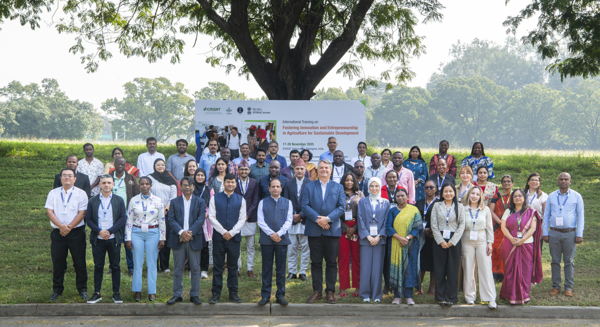
This question anchored the International Training on Agri-Entrepreneurship for Women and Youth – Small-Scale Food Processing Enterprises, organized by ICRISAT from 19 - 30 January 2026 under the Indian Technical and Economic Cooperation (ITEC) Programme of the Ministry of External Affairs, Government of India.
The international program brought together 35 participants from 22 countries, representing farmers, entrepreneurs, policymakers, and educators from across the Global South. United by a shared objective, the cohort explored practical pathways to move beyond primary production and unlock the economic potential of value addition and market-led agri-entrepreneurship.
At the inaugural session, Dr Himanshu Pathak, Director General of ICRISAT, underscored the strategic role of South–South collaboration in strengthening agri-entrepreneurship and highlighted the ICRISAT Center of Excellence for South-South Cooperation in Agriculture (ISSCA) initiative.
“When women and youth from the Global South unite to pursue agripreneurship, they become key drivers who turn crops into safe, nutritious, and affordable foods.
This training demonstrates how one can turn local challenges into scalable enterprise opportunities that strengthen rural economies while building resilient, market-ready food systems,” Dr Pathak said.

Small-scale food processing enterprises play a critical role in reducing postharvest losses, responding to growing demand for safe and nutritious foods, and generating employment close to the farm. Designed with this reality in mind, the course equipped participants with technical skills, entrepreneurial thinking, and business planning capabilities to establish and manage viable food enterprises.
The curriculum covered hands-on learning in processing technologies, quality control, packaging, branding, marketing, financial literacy, and enterprise management.
Participants visited ICRISAT’s Agribusiness Innovation and Nutrition (AIN) platform and the Product Development and Pilot Processing Unit. They also visited ICRISAT’s research facilities, including the Genebank, the Charles Renard Analytical Laboratory (CRAL), and the Genomics and Insect laboratories.
They also visited other national institutions, including the NutriHub at the Indian Institute of Millet Research, AgriGhar, and the Rural Technology Park at NIRD, observing how research-led innovations are translated into market-ready products.
Reflecting on the dire need for skill building, Dr Stanford Blade, Deputy Director General – Research and Innovation, noted:
“This program reinforces a simple but powerful truth that sustainable agri-enterprises are built at the intersection of science, entrepreneurship, and markets.
“When these elements align, innovation moves beyond laboratories and becomes a driver of real economic change,” added Dr Blade


A team-based business pitching exercise formed the backbone of the training. Participants also had the opportunity to attend the National IP Yatra 2026, hosted by ICRISAT, and gain exposure to intellectual property rights for commercializing innovations.
Participant, Ms Essia Maghrebi form the National Agronomic Institute of Tunisia noted:
“This training changed how I look at everyday challenges. What I will take back to my country is this: where there is a gap, there is business.”
Reflecting on the outcomes, course directors Dr Padmaja Ravula, Principal Scientist - Sociologist, Gender & Nutrition Research, and Mr Purushotham Rudraraju, Manager – Agribusiness Relations, emphasized that the training went beyond technical learning to build participants’ entrepreneurial acumen.

Gallery
 Participants tour the ICRISAT Headquarters
 Participants at the Genebank
 Participants' visit to the Product Development and Pilot Processing Unit


This work aligns with SDG 17

Roseleen Aind
Related Articles: