New Research Identifies Promising Crops to Strengthen Saudi Arabia’s Food and Feed Security
ICRISAT–FAO partnership identifies sorghum and pearl millet candidates that can boost both food grain and livestock fodder production in Saudi Arabia’s dryland farming systems.

New research from ICRISAT has identified five promising sorghum and pearl millet candidates with the potential to strengthen Saudi Arabia’s food and livestock feed security, offering farmers in water-scarce regions the prospect of producing both grain and fodder from a single crop.
The findings, published in Frontiers in Plant Science, emerge from a research partnership between the International Crops Research Institute for the Semi-Arid Tropics (ICRISAT), the Food and Agriculture Organization of the United Nations (FAO), and the Sustainable Agricultural Rural Development Programme (Saudi REEF) of the Ministry of Environment, Water and Agriculture (MEWA) of Saudi Arabia.
The initiative evaluated 27 sorghum and 15 pearl millet entries across contrasting lowland and highland environments in Jazan and Abha, identifying candidates with favorable combinations of grain yield and fresh biomass production.


Commending the collaboration with FAO and the Government of Saudi Arabia, Dr Himanshu Pathak, Director General of ICRISAT, highlighted the importance of scientific partnerships in advancing Saudi Arabia’s food security ambitions.
“Saudi Arabia’s commitment to strengthening food security in one of the world’s most water-scarce environments speaks to a challenge of global significance.
“Through our partnership with FAO and the Government of Saudi Arabia, we are bringing together scientific expertise and a shared vision to unlock the potential of dryland agriculture, strengthen domestic food and livestock feed security, and build a more resilient agricultural future for Saudi Arabia.
“This work is helping lay the foundation to create lasting economic opportunities for farmers across the Kingdom,” said Dr Pathak.
Dr Kakoli Ghosh, Chief Technical Adviser, Sustainable Rural Agricultural Development Programme, FAO Saudi Arabia, further emphasized the importance of this partnership and research tailored to local conditions.
“Sorghum and pearl millet can provide both grain and livestock feed, making them valuable crops for Saudi Arabia. Identifying cultivars suited to local conditions is an important step toward strengthening domestic production and supporting farmers.
“This partnership is helping translate research into practical options for the Kingdom’s agrifood systems,” said Dr Ghosh.
Promising Candidates for Food and Livestock Feed
The research identified three sorghum candidates with promising performance across the combined grain yield and fresh biomass selection criteria. The best-performing sorghum entry exceeded the best check by 9.3% in grain yield and 41.3% in fresh biomass.
Two pearl millet candidates also demonstrated favorable combinations of grain and fresh biomass production. The best-performing pearl millet entry exceeded the best check by 33.9% in grain yield, although its fresh biomass yield was 37.1% lower than that of the best check.
According to Dr Ephrem Habyarimana, the project's Principal Investigator and Principal Scientist, Sorghum Breeding at ICRISAT, and Dr SK Gupta, Principal Scientist, Pearl Millet Breeding at ICRISAT, the selected materials provide a basis for further testing of dual-purpose crops suited to Saudi Arabia's farming conditions.
Dr Raman Babu, Global Research Program Director – Accelerated Crop Improvement at ICRISAT, said their ability to produce both grain and livestock fodder could help farmers increase the productive value of agricultural land while supporting local feed supplies.
“The complexities of dryland environments demand approaches that go beyond selecting for a single trait. Multi-trait selection helps breeders identify crop candidates that balance different priorities, from grain production to biomass for livestock feed.
“This is an important step toward developing more relevant options for farming systems facing multiple pressures, including water scarcity and climate variability,” said Dr Babu.


From Scientific Discovery to Farmers' Fields
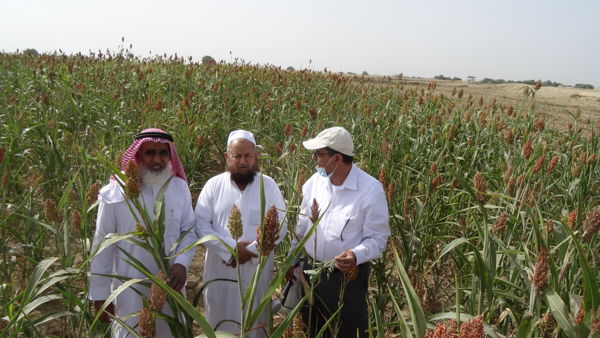
Conducted across four site-season environments at the Jazan Agricultural Research Center and the Seed Multiplication Station in Abha, the research has generated a portfolio of Saudi-tested crop candidates and peer-reviewed evidence to guide future investment in crop improvement.
The next phase should focus on farmer-managed trials, fodder-quality and water-productivity assessments, seed multiplication and national registration to determine which candidates are suitable for wider adoption.
Farmers and livestock keepers will play a key role in assessing crop performance, feeding value and practical suitability under everyday farming conditions.
Successfully validated crops would offer Saudi Arabia a practical opportunity to strengthen domestic grain and fodder production, improve the resilience of crop-livestock farming systems and expand agricultural options for farmers in Jazan, the Asir highlands and similar dryland environments.
Read the study: Frontiers in Plant Science


This work aligns with SDGs 1, 2, 13 & 17

Roseleen Aind
Related Articles: