ICRISAT Pearl Millet Field Day Highlights Breeding Advances for Farmers’ Needs, Climate Resilience and Market Potential
The much-anticipated event brought together eighty scientists from public research institutions and the seed industry to assess promising pearl millet breeding materials, exchange insights and shape priorities for improved productivity, nutrition, climate resilience and future economic opportunities for dryland farmers.

ICRISAT is advancing frontier pearl millet breeding to improve farm productivity, strengthen climate resilience and support long-term economic opportunities for smallholder farmers. By developing materials with improved grain quality, drought tolerance and fodder value, the research aims to help farmers derive greater value from pearl millet in dryland farming systems.
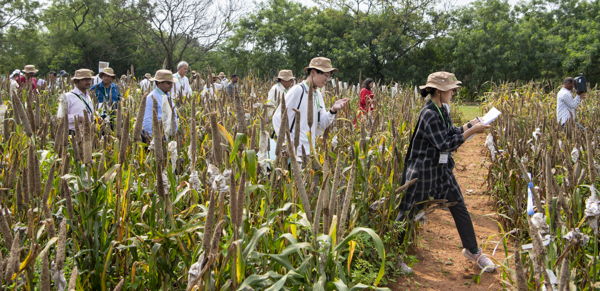
These priorities took center stage at ICRISAT's biennial Pearl Millet Scientists' Field Day, held on 12–13 October 2026, bringing together 80 scientists from public- and private-sector institutions in India, Africa, Japan and other regions to evaluate and select advanced breeding materials.
The event followed the recent release by ICRISAT and the Indian Council of Agricultural Research (ICAR) of RHB 273, the world's first three-way pearl millet hybrid. Developed for India's low-rainfall A1 zone, the hybrid combines promising traits for grain productivity, drought tolerance and superior fodder quality, with potential benefits for farm profitability and livestock production.

Opening the event, ICRISAT Director General Dr Himanshu Pathak emphasized the importance of research that responds to farmers' needs and evolving agricultural markets.
“Our focus is on advancing science that responds to these needs. Through strong breeding research and public- and private-sector collaboration, we aim to develop improved crop options that deliver practical value for farmers,” said Dr Pathak.

The field day showcased 16,000 plots of breeding materials, including 8,000 B lines, 8,000 R lines and 2,000 forage lines. Scientists evaluated traits associated with drought and heat tolerance, disease resistance, early maturity, improved grain quality and enhanced fodder value.
The materials offer potential avenues for improving crop performance and fodder quality. Materials with higher protein content, brown midrib (bmr) traits and sweet-stalk characteristics were also evaluated as they offer opportunities for value addition across food, feed and biomass markets.
Dr Stanford Blade, ICRISAT's Deputy Director General – Research and Innovation, highlighted the importance of sustained scientific investment.
“The breadth of genetic material available to pearl millet breeders gives us a strong foundation to push the boundaries of crop improvement. Our responsibility is to build on this resource through sustained scientific investment and a clear long-term vision, expanding the possibilities for pearl millet across diverse farming systems," said Dr Blade.

Collaboration with public research institutions and private seed companies remains central to translating breeding advances into improved hybrids for farmers.
Dr Raman Babu, Global Research Program Director – Accelerated Crop Improvement at ICRISAT, highlighted the role of the Hybrid Parents Research Consortium (HPRC) in strengthening hybrid development.
“Hybrid development depends on identifying and combining the right parental lines for specific breeding objectives. Continued evaluation and partner feedback help determine which materials merit further attention,” said Dr Babu.
Dr SK Gupta, Principal Scientist for Pearl Millet Breeding at ICRISAT, noted that feedback from the 2024 field day had informed breeding efforts to improve grain color, drought tolerance, blast resistance, and forage quality.
Using approaches such as forward and shuttle breeding, ICRISAT has developed more productive and better-adapted breeding materials for drought-prone environments, including India’s A1 zone, as designated by the All India Coordinated Research Project (AICRP) on Pearl Millet.


Participants also recommended shorter, early-maturing parental lines to reduce lodging and support mechanized harvesting, with potential benefits for production efficiency and labor costs.
The research also aligns with broader efforts under MAHARISHI (Millets And OtHer Ancient Grains International ReSearcH Initiative), supported by collaboration with ICAR and industry partners to advance millet improvement across diverse farming environments.
ICRISAT’s ongoing breeding efforts aim to deliver improved pearl millet varieties that help farmers increase productivity, earn better returns and access new markets across India, Africa and other dryland regions.
View the Video


This work aligns with SDGs 1, 2, 13 & 17

Roseleen Aind
Related Articles: