From Plot to Policy: Evidence, Incentives and Convergence Needed to Scale Regenerative Agriculture
Special session co-organized by ICRISAT at the 34th Annual AERA Conference highlights the need for credible evidence specific to agro-ecologies and farming systems, farmer-centered transition support, stronger extension and market incentives.

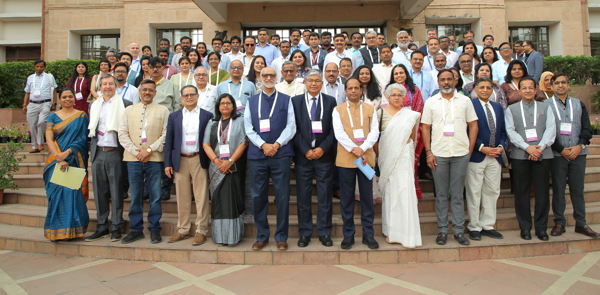
The panel framed regenerative agriculture as a systems concept rather than a single prescribed practice. Farming rebuilds soil health, water and biodiversity while keeping the farmers profitable and resilient. Regenerative agriculture will not move from promising field practices to mainstream policy through short-term schemes or isolated technologies alone. It requires a systems approach that makes the transition workable for farmers while aligning evidence, incentives, extension, markets and institutions. This was the central message from a special session, 'From Plot to Policy: Pathways for Mainstreaming Regenerative Agriculture,' held during the 34th Annual Agricultural Economics Research Association (AERA) Conference at Pondicherry University, Puducherry on 13 October 2026.
Jointly organized by ICRISAT, IFPRI, ICAR-NIAP and the CGIAR India Policy Innovation Hub, the session brought together economists, researchers, policy experts, industry and practitioners. It was chaired by Dr PG Chengappa, Former Vice Chancellor, University of Agricultural Sciences, Bangalore.
Dr Shalander Kumar, Global Theme Leader - Socioeconomics, Inclusion and Impact at ICRISAT and Co-Lead CGIAR India Policy Innovation Hub, convened the session and framed the discussion around a practical question: how can regenerative agriculture become rewarding and scalable for farmers?
Five messages emerged from the discussion
- Move from practices to systems. Regenerative agriculture was framed as a systems transition involving farming practices, input use, soil and water management, farmer knowledge, markets and institutional support. Pathways therefore need to be context-specific rather than based on a single prescribed package.
- Make the transition feasible for farmers. Farmers may face adjustment costs, production risks and delayed benefits during transition. Short-duration support is unlikely to be sufficient where soil health, input use and farm management take several seasons to stabilize.
- Build credible, long-term evidence. Measurement should go beyond adoption or yield to include input and fertilizer use, water savings, soil health and biology, productivity, farm income and risk, with indicators appropriate to plot, farm, district and landscape scales.
- Align policies and incentives. Current support mechanisms were discussed as often favoring input-intensive production. Better convergence across schemes and departments, market differentiation and possible payments for ecosystem services require further attention.
- Explore market incentives and payment-for-ecosystem-services approaches where outcomes can be credibly measured.
- Strengthen extension, markets and local institutions. Sustained extension, capable local resource persons, FPOs, NGOs, infrastructure and value-chain connections were highlighted as essential for adoption and scale. The discussion also stressed that women’s participation and labor constraints must be considered explicitly in program design.
Productivity must be assessed at the system level
During the cross-panel discussion, Dr Shalander Kumar underscored that agricultural policies remain strongly oriented towards input-intensive systems and that the transition to regenerative agriculture will require a broader view of productivity. He called for long-term data and evidence that assess systems productivity, not only the performance of a single crop, while also examining risk and the conditions under which regenerative approaches work.
The session’s concluding synthesis reinforced that regenerative agriculture cannot be scaled simply by promoting individual practices. Wider adoption will depend on making the transition economically and operationally feasible for farmers, aligning policy instruments, strengthening extension and capacity, building market and value-chain incentives, and establishing credible frameworks to measure both economic and environmental outcomes.
For research and policy, the next steps identified include mapping existing schemes and conflicting incentives; clarifying who bears transition costs; strengthening evidence on yield, income, input use, water and soil health; developing measurement frameworks across scales; and building institutional arrangements that connect government, research, extension, NGOs and markets.



Ramon Peachey